

Starting a family is an important personal journey, but some couples may experience difficulties when trying to conceive naturally. Fertility challenges can occur due to several factors involving reproductive health, hormonal imbalances, egg quality, sperm health, or problems affecting the uterus and fallopian tubes. When pregnancy does not occur despite trying for an appropriate period, medical evaluation can help identify possible causes and suitable treatment options.
In vitro fertilisation (IVF) is an assisted reproductive technology that helps individuals and couples experiencing certain fertility problems. The procedure involves collecting eggs from the ovaries, fertilising them with sperm in a laboratory, and transferring a selected embryo into the uterus. Although IVF involves several medical stages, understanding each step can help patients feel more prepared and make informed decisions.
Treatment planning is individualised because fertility conditions, medical history, age, and reproductive health vary from person to person. Understanding the IVF process, from initial fertility investigations to embryo transfer, provides a clearer picture of what patients may expect during treatment.
1. What Is IVF and How Does It Work?
In vitro fertilisation is a fertility treatment in which egg fertilisation takes place outside the body in a specialised laboratory. The resulting embryo is monitored during its early development before a suitable embryo is selected for transfer into the uterus.
The main objective of IVF is to help achieve pregnancy when natural conception is difficult or when other fertility treatments may not be appropriate.
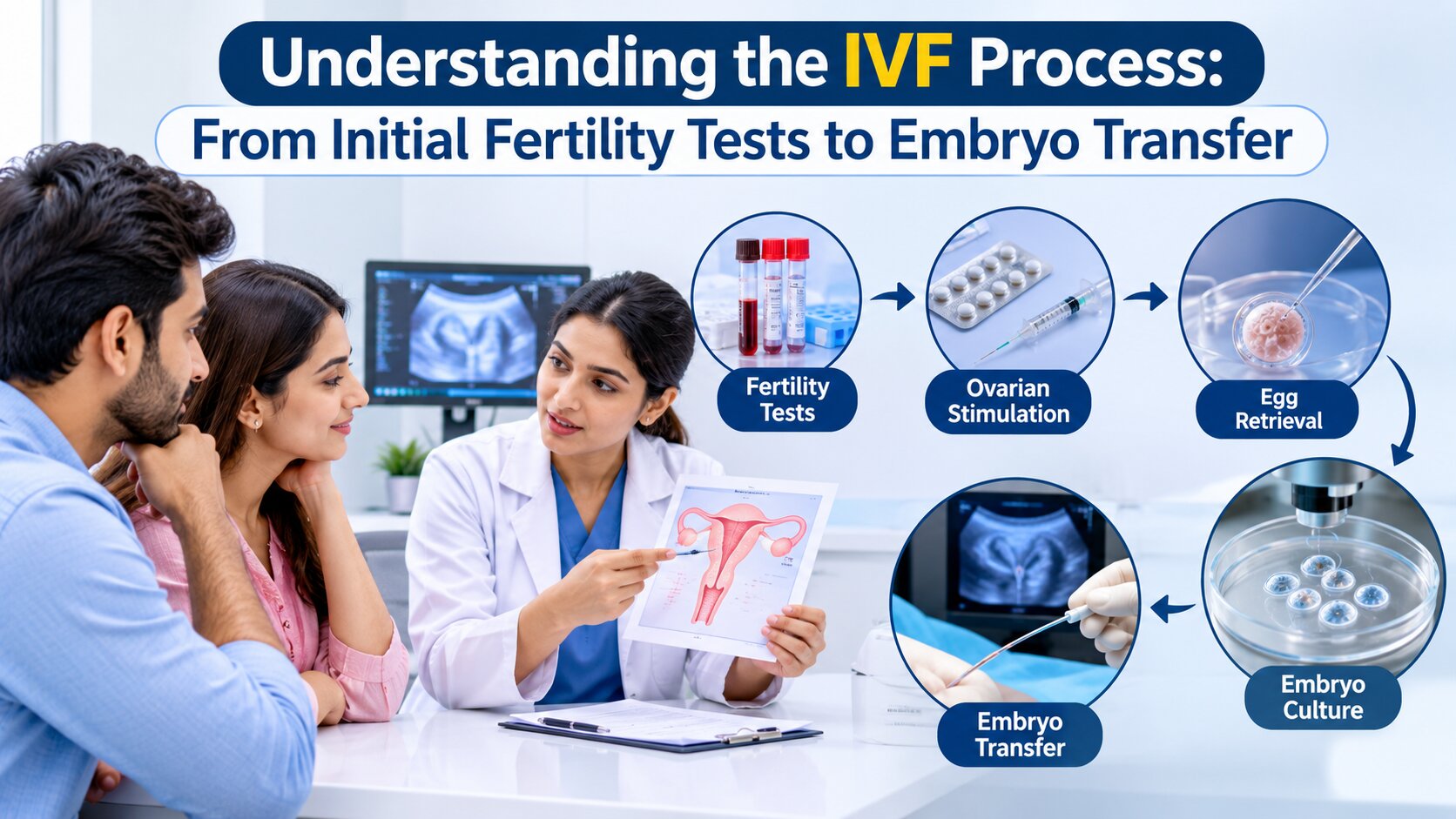
The general IVF process includes:
-
Initial fertility assessment and medical consultation.
-
Ovarian stimulation using prescribed medications.
-
Monitoring of follicle development.
-
Egg retrieval from the ovaries.
-
Collection and preparation of sperm.
-
Fertilisation in a laboratory.
-
Embryo development and assessment.
-
Embryo transfer into the uterus.
-
Pregnancy testing and follow-up.
Not every patient follows exactly the same treatment schedule. Doctors may modify the approach according to ovarian response, embryo development, and individual medical requirements.
2. Initial Fertility Assessment and Medical Tests
The first stage of IVF involves understanding why pregnancy has not occurred and whether assisted reproductive treatment is suitable. Both partners may undergo investigations because fertility difficulties can involve male, female, or combined factors.
For women, the evaluation may include:
Medical and Menstrual History: Doctors review menstrual cycle patterns, previous pregnancies, medical conditions, surgeries, and earlier fertility treatments.
Hormonal Testing: Blood tests may measure hormones such as AMH, FSH, LH, and thyroid-stimulating hormone, depending on the patient's history and clinical requirements.
Ultrasound Examination: A pelvic or transvaginal ultrasound helps assess the uterus, ovaries, and antral follicle count.
Uterine Assessment: Additional investigations may be recommended to evaluate the uterine cavity and identify fibroids, polyps, or other abnormalities that could affect implantation.
For men, semen analysis is commonly performed to assess sperm concentration, movement, and shape. Additional tests may be advised when necessary.
These investigations help doctors develop an individual treatment plan and identify whether IVF, another fertility treatment, or further evaluation is appropriate.
3. Ovarian Stimulation and Follicle Monitoring
After the initial assessment, the next stage may involve ovarian stimulation. During a natural menstrual cycle, usually one egg matures and is released. IVF medications are used to encourage the development of multiple follicles so that more than one egg may be available for retrieval.
The treatment generally involves prescribed hormonal injections over several days. The exact medication and duration depend on the patient's ovarian reserve, age, medical history, and response to treatment.
During this stage, doctors monitor ovarian activity through:
-
Ultrasound examinations to measure follicle growth.
-
Blood tests to evaluate relevant hormone levels.
-
Assessment of the number and size of developing follicles.
-
Adjustments to medication when clinically necessary.
When the follicles reach an appropriate stage of development, a trigger medication is administered to help prepare the eggs for retrieval.
Close monitoring is important because excessive ovarian response can increase the risk of ovarian hyperstimulation syndrome (OHSS), a potentially serious complication.
4. Egg Retrieval Procedure
Egg retrieval, also called oocyte retrieval, is a procedure performed to collect mature eggs from the ovaries.
It is generally carried out under sedation or anaesthesia. Using ultrasound guidance, the doctor passes a specialised needle through the vaginal wall into the ovarian follicles to collect the follicular fluid containing the eggs.
The collected material is sent to the embryology laboratory, where specialists identify and assess the retrieved eggs.
Some important points about egg retrieval include:
-
The procedure is usually completed within a relatively short period.
-
Patients are monitored after the procedure.
-
Mild cramping or temporary discomfort may occur.
-
Recovery instructions are provided by the treating medical team.
-
The number of eggs retrieved can vary between patients.
The number of eggs collected does not necessarily determine the final number of embryos because not every egg will be mature, fertilised, or develop successfully.
5. Sperm Collection and Preparation
Along with egg retrieval, sperm collection is another important stage of IVF. A semen sample is generally collected from the male partner on the day of egg retrieval or according to the treatment schedule.
The laboratory team examines the sample and prepares it to identify sperm with suitable characteristics for fertilisation.
Depending on sperm quality and the couple's medical circumstances, different fertilisation techniques may be considered.
Conventional IVF: In this method, prepared sperm and mature eggs are placed together in a laboratory dish to allow fertilisation to occur naturally.
Intracytoplasmic Sperm Injection (ICSI): In this technique, a single selected sperm is injected directly into a mature egg using specialised laboratory equipment. It may be recommended in certain cases of male-factor infertility or previous fertilisation difficulties.
The choice between conventional IVF and ICSI depends on clinical findings and the fertility specialist's recommendation.
6. Fertilisation and Embryo Development
After egg retrieval and sperm preparation, fertilisation takes place in the embryology laboratory. The embryologist checks the eggs to determine which have successfully fertilised.
The fertilised eggs begin dividing and developing into embryos. Their development is monitored under controlled laboratory conditions.
Embryos may be assessed at different stages, including:
-
Day 1: Fertilisation is checked, and normally fertilised eggs are identified.
-
Day 2–3: Embryos continue dividing into multiple cells.
-
Day 5–6: Some embryos develop into the blastocyst stage, which has a more advanced cellular structure.
Not every fertilised egg develops into a suitable embryo. The embryology team evaluates development and morphology to help identify embryos that may be appropriate for transfer or freezing.
In selected cases, preimplantation genetic testing may also be discussed. This involves additional procedures and is recommended only for specific medical indications after appropriate counselling.
7. Embryo Transfer Procedure
Embryo transfer is one of the important stages of IVF treatment. It involves placing a selected embryo into the uterus with the aim of achieving implantation and pregnancy.
The procedure is generally performed using a thin, flexible catheter. The doctor guides the catheter through the cervix and carefully releases the embryo into the uterine cavity, often with ultrasound guidance.
Embryo transfer may be performed in two main ways:
Fresh Embryo Transfer: An embryo is transferred during the same treatment cycle in which the eggs were collected, provided the uterine lining and other clinical conditions are suitable.
Frozen Embryo Transfer: An embryo that was previously frozen is thawed and transferred during a later cycle. This approach may be recommended when the doctor considers it more appropriate for the patient's medical condition.
The timing and number of embryos transferred are determined according to individual circumstances, embryo quality, age, and applicable medical guidelines. Transferring more embryos is not necessarily better because it can increase the possibility of multiple pregnancy.
8. What Happens After Embryo Transfer?
After embryo transfer, patients enter the waiting period before pregnancy testing. During this time, the embryo may attach to the uterine lining and begin the process of implantation.
Doctors may prescribe progesterone or other medications to support the uterine lining, depending on the treatment protocol.
Some general recommendations include:
-
Follow the prescribed medication schedule.
-
Continue normal light daily activities as advised.
-
Avoid strenuous exercise if instructed by the doctor.
-
Attend scheduled follow-up appointments.
-
Contact the medical team if unusual pain, heavy bleeding, or other concerning symptoms occur.
Strict bed rest is generally not required after an uncomplicated embryo transfer. Patients should follow their treating specialist's instructions rather than relying on unverified precautions.
A blood test measuring beta-hCG is generally performed at the recommended time to check whether pregnancy has occurred. Testing too early may produce misleading results.
9. Factors That Can Influence IVF Treatment Outcomes
IVF outcomes vary between individuals because several medical and biological factors influence fertilisation, embryo development, implantation, and pregnancy.
Some important factors include:
Age of the Woman: Age is an important factor because egg quantity and quality generally decline over time, particularly as women approach their late thirties and forties.
Ovarian Reserve: Ovarian reserve provides information about the remaining egg supply and may influence the response to stimulation medications.
Sperm Health: Sperm concentration, movement, and other characteristics can influence fertilisation and embryo development.
Uterine Health: The condition of the uterine cavity and endometrial lining can affect the suitability of the uterus for embryo transfer.
Embryo Development: The developmental stage and quality of embryos are important considerations during treatment planning.
Underlying Medical Conditions: Conditions such as endometriosis, PCOS, thyroid disorders, and certain uterine abnormalities may influence fertility and treatment decisions.
It is important to remember that IVF cannot guarantee pregnancy. A fertility specialist can explain individual chances of success based on clinical history and relevant investigations.
10. Choosing the Right Fertility Specialist and Treatment Centre
Choosing an appropriate fertility specialist is an important decision because IVF requires coordination between doctors, embryologists, laboratory professionals, and nursing staff.
When considering an IVF Centre in Kota, patients should evaluate the available fertility services, laboratory facilities, treatment protocols, and experience of the medical team.
Some important considerations include:
-
Availability of comprehensive fertility investigations.
-
Qualified fertility specialists and embryologists.
-
Laboratory facilities for fertilisation and embryo culture.
-
Availability of conventional IVF and ICSI when required.
-
Proper patient counselling and treatment guidance.
-
Transparent information about treatment costs and possible outcomes.
-
Follow-up support throughout the treatment process.
Patients seeking Infertility Treatment in Kota should also consider whether the centre provides individualised treatment plans rather than recommending the same approach to every couple.
Consulting the Best Gynecologist in Kota or an appropriately qualified fertility specialist can help patients understand their reproductive health, available treatment options, and the investigations required before starting IVF.
Conclusion
IVF is a multi-stage fertility treatment that involves medical evaluation, ovarian stimulation, egg retrieval, sperm preparation, fertilisation, embryo development, and embryo transfer. Each stage plays an important role in the overall treatment process.
Understanding these steps helps couples prepare for treatment and develop realistic expectations. Since fertility requirements differ between individuals, the treatment approach should always be based on medical investigations, reproductive health, and professional guidance.
Choosing an experienced fertility team and following the recommended treatment plan can help patients navigate their fertility journey with better information and confidence.
Frequently Asked Questions (FAQs)
1. What is the first step in the IVF process?
The first step is a fertility consultation and medical evaluation. Doctors review both partners' medical histories and recommend investigations to understand the possible causes of infertility.
2. How many stages are involved in IVF treatment?
IVF generally involves fertility assessment, ovarian stimulation, egg retrieval, sperm preparation, fertilisation, embryo development, embryo transfer, and pregnancy testing.
3. Is IVF a painful procedure?
Some stages may cause temporary discomfort, such as bloating during ovarian stimulation or mild cramping after egg retrieval. Egg retrieval is generally performed under sedation or anaesthesia.
4. How long does one IVF cycle take?
An IVF cycle commonly takes around four to six weeks from the beginning of ovarian stimulation to pregnancy testing. The timeline can vary depending on the treatment protocol and whether a fresh or frozen embryo transfer is planned.
5. What is the difference between fresh and frozen embryo transfer?
Fresh embryo transfer takes place during the same cycle as egg retrieval, while frozen embryo transfer involves using an embryo that was previously frozen and is transferred during a later cycle.
6. Does IVF guarantee pregnancy?
No. IVF does not guarantee pregnancy. Treatment outcomes depend on factors such as age, egg quality, sperm health, embryo development, and uterine conditions.
7. What should patients avoid after embryo transfer?
Patients may be advised to avoid strenuous physical activities and follow specific medication and lifestyle instructions. Normal light activities are generally acceptable, and strict bed rest is not routinely necessary.
8. When should couples consider IVF treatment?
Couples may consider IVF after fertility evaluation when natural conception has been difficult or when other treatments have not been successful. The timing depends on age, medical history, and the underlying fertility condition.